
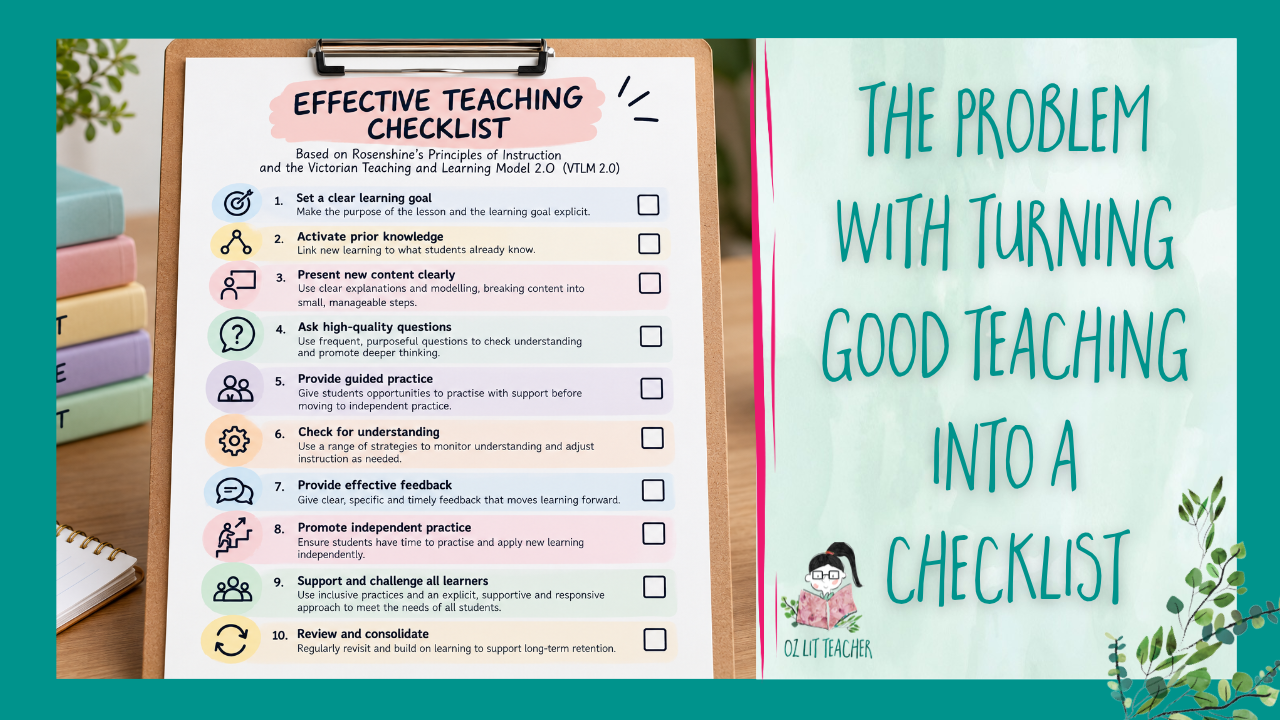
The Problem with Turning Good Teaching into a Checklist
Oct 25, 2026I've been head down, bum up, working on my Master's dissertation recently. This has had me poring over piles of journal articles on teaching, literacy instruction, and grammar. As part of this, I recently rediscovered a couple of articles I first came across about 15 years ago, when I was completing my other Master's degree. Reading them, I was struck by how relevant they are to today's schools; even though they were written way back in the 80s, they could have been written last week!
So, what's missing?
In these articles, Lee Shulman (1986, 1987) talks about how researchers at the time were busy trying to identify the teaching practices that made some teachers more effective than others. Education policymakers then started using these lists to define what good teaching should look like.
The focus was on things that could be easily seen and measured in classrooms. Things like how teachers asked questions, managed classroom discussions, structured lessons and provided feedback. He even mentions the fact that some of this research came from a guy called Rosenshine (among others)... sound familiar?
Just to be clear, Shulman wasn't suggesting that these things weren't important, BUT he was concerned that, in all the excitement about identifying effective teaching practices, something incredibly important was being overlooked- teacher content knowledge!
This particular passage really got me thinking:
"The essential goal of this program of research has been to identify those teacher behaviors and strategies most likely to lead to achievement gains among students. Because the search has focused on generic relationships— teacher behaviors associated with student academic gains irrespective of subject matter or grade level —the findings have been much more closely connected with the management of classrooms than with the subtleties of content pedagogy. That is, the effective-teaching principles deal with making classrooms places where pupils can attend to instructional tasks, orient themselves toward learning with a minimum of disruption and distraction and receive a fair and adequate opportunity to learn. Moreover, the educational purposes for which these research results are most relevant are the teaching of skills. Rosenshine (1986) has observed that effective teaching research has much less to offer to the teaching of understanding, especially of complex written material; thus, the research applies more to teaching a skill like multiplication than to teaching critical interpretations of, say, the Federalist papers." (L. Shulman, 1987, p.10).
Shulman's point in the articles was that the world of education had become so focused on how teachers teach that it had forgotten the importance of what teachers needed to know in order to teach well.
"Discovering, explicating, and codifying general teaching principles simplify the otherwise outrageously complex activity of teaching. The great danger occurs, however, when a general teaching principle is distorted into prescription, when that maxim becomes mandate. Those states that have taken working principles of teaching, based solely on empirical studies of generic teaching effectiveness, and have rendered them as hard, independent criteria for judging a teacher's worth, are engaged in a political process likely to injure the teaching profession rather than improve it." (L.Shulman, 1987, p.11).
Here we go again!
YIKES! Fast-forward 40 years and I can't help but wonder whether we're at risk of repeating the exact same thing all over again. 😬
At the moment, there seems to be an enormous focus on the observable behaviours in classrooms (think Rosenshine's Principles of Instruction). Schools are spending considerable time unpacking these teaching practices, adding icons of them to PowerPoint slides and looking for evidence of them in classroom observations. And, I absolutely agree that strategies such as Checking for Understanding are important in classroom instruction... BUT I also believe that these strategies require deep teacher content knowledge to be executed effectively. If a teacher doesn't understand the content they're teaching (including what comes before and after a particular concept), how can they possibly use what they've learnt from Checking for Understanding to decide what to teach next? Or provide rich feedback?
As Shulman reminds us in these articles, to teach well, teachers need knowledge of teaching strategies AND knowledge of content.
And, as I've said before, this content knowledge can NOT be replaced by or outsourced to PowerPoint slides. Having a prepared slide deck is one thing. Having the knowledge to explain the content, answer students' questions and respond when things don't go to plan is something else entirely!
What does this mean for literacy instruction?
Well, it means spending time unpacking teaching strategies such as Opportunities to Respond, Check for Understanding, etc., BUT also setting aside time to build teachers' content knowledge in phonics, comprehension, grammar, and writing.
Here's something worth reflecting on: Think about the professional learning that's happened in your school over the past 12 months. How much of that time has been spent developing teachers' knowledge of HOW to teach, compared with building their knowledge of WHAT they're teaching?
I have many more thoughts about this, but for now, I'll leave you with that bit of food for thought as I really need to get back to my essay writing!
References:
If you're interested in reading more, here are the two Shulman articles that got me thinking:
- Shulman, L. (1987). Knowledge and teaching: Foundations of the new reform. Harvard Educational Review, 57(1), 1–23. https://doi.org/https://doi.org/10.17763/haer.57.1.j463w79r56455411
- Shulman, L. S. (1986). Those who understand: Knowledge growth in teaching. Journal of Education, 193(3), 1–11. https://doi.org/10.1177/002205741319300302
Related Blog Posts:
Sign up to our mailing list
Join our mailing list to receive the latest news, updates and resources from Oz Lit Teacher.
We'll even give you a copy of our mentor text list to say thanks for signing up.
Meet The Author

