
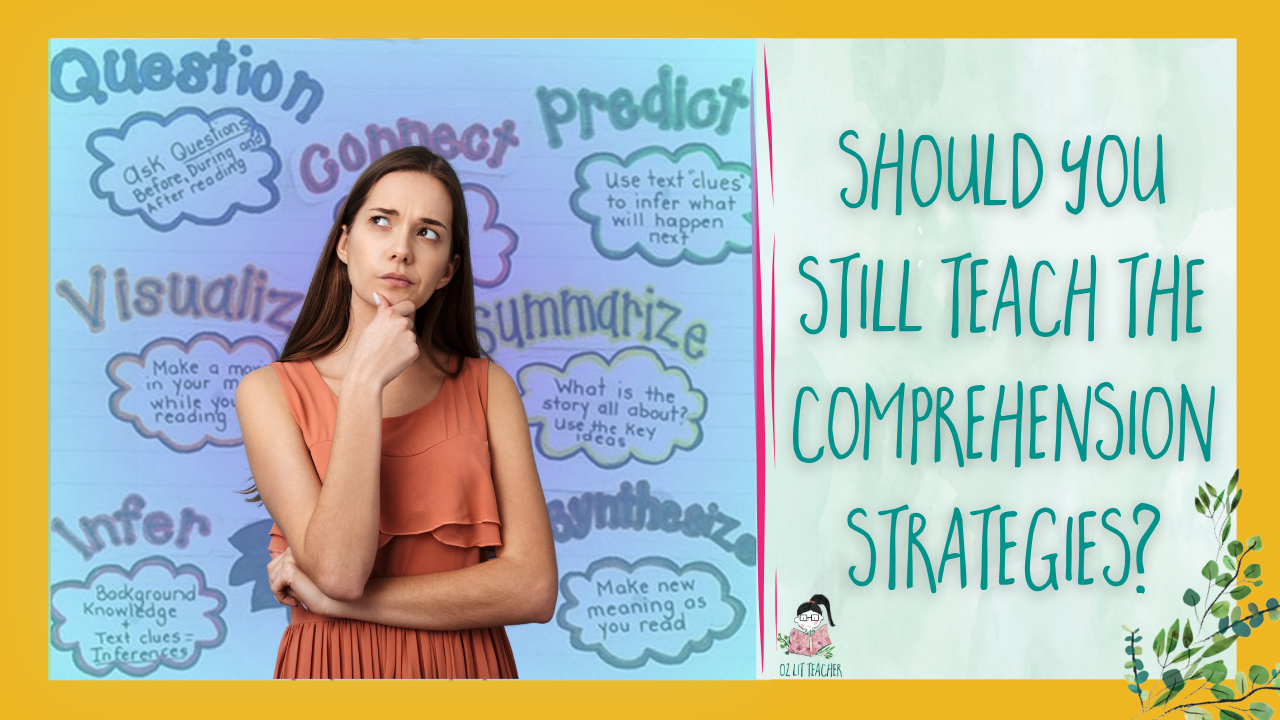
Should you still teach the comprehension strategies?
Aug 09, 2026I recently received a great question from one of the participants in my Comprehension Rethink course:
If comprehension is more than strategies, why are they still such a big part of the curriculum?
The questioner had just completed the first module of my course, where I explain why strategy-based instruction isn’t sufficient and outline the modern elements of comprehension that research suggests we should be focusing on instead.
In this summary, I share Daniel Willingham’s suggestion that strategy instruction should only be a 'very small' component of your comprehension teaching:
“There's no evidence that extensive practice with these strategies yields an advantage over a brief intervention- say, 10 lessons...” (Willingham, 2017).
(Not going to lie, that was a hard pill to swallow when I first started diving into the comprehension research!)
But aren’t comprehension strategies in the curriculum?
Yes, the curriculum does mention comprehension strategies.
They sit in the Literacy strand, under the Analysing, Interpreting and Evaluating sub-strand, and look similar to this Year 4 version:
Use comprehension strategies such as visualising, predicting, connecting, summarising, monitoring and questioning to build literal and inferred meaning, to expand topic knowledge and ideas, and evaluate texts (AC9E4LY05)(VC2E4LY09)(WA4ELYA3).
It’s important to note, though, that this content descriptor makes up just 1 out of the 20 reading-related content descriptors (which means that comprehension strategies are only 5% of the full story!). This fact alone makes it hard to justify the amount of time we used to spend teaching them. 😳
So, what should we teach instead?
Research now provides a broader picture of what it takes for a reader to comprehend a text. We now know that readers draw on a wide range of knowledge and skills in order to make sense of what they're reading.
The importance of background knowledge, for example, has been underemphasised in the past, but is now widely recognised as being a critical contributor to comprehension. Vocabulary is another key element that can not be ignored.
In addition to these two major -and often talked about- contributors, though, there are a range of other building blocks too, including: syntax knowledge (i.e. understanding the structure of individual sentences), inferring capacity (see my recent blog post on this topic), knowledge of text structure and, when dealing with fiction texts, theory of mind.
These elements all make up the teacher content knowledge side of teaching reading comprehension in the modern classroom. (See this post for more information on the three knowledge areas that teachers need to teach any subject effectively).
FYI: I explain each of these elements in much greater detail in my Comprehension Rethink course. Also, in the final module of this course, I share reading units and lesson plans to help you visualise the practicalities of teaching comprehension with these critical building blocks in mind.
In summary...
To answer the original question: comprehension strategies haven't completely disappeared; we've now developed a better understanding of their role in comprehension. They rely on a stack of knowledge and skill-based building blocks being in place before they can be used effectively by readers.
Related Blog Posts:
References:
- Willingham, D. T. (2017). The reading mind: A cognitive approach to understanding how the mind reads. Jossey-Bass.
Sign up to our mailing list
Join our mailing list to receive the latest news, updates and resources from Oz Lit Teacher.
We'll even give you a copy of our mentor text list to say thanks for signing up.
Meet The Author

